Flexor and Extensor Tendon Injuries
A condition that impairs hand and finger movement due to tendon damage
The tendons in your hand and wrist play a vital role in movement, connecting muscles in your forearm to the bones of your fingers and thumb. These tendons allow you to bend (flexor tendons) and straighten (extensor tendons) your fingers, making everyday tasks such as gripping, writing, and lifting possible.
When a tendon is injured, movement of the affected finger or thumb can be significantly limited. Flexor tendon injuries may prevent you from bending the finger, while extensor tendon injuries may stop you from straightening it. These injuries can occur due to cuts, crush injuries, or even sudden forceful movements that strain the tendon.
Causes of Flexor and Extensor Tendon Injuries
Flexor and extensor tendons in the hand and wrist are strong but vulnerable because of their location just beneath the skin. Injuries can occur suddenly through trauma or gradually from overuse. The most common causes include:
- Cuts and lacerations
- Sharp objects such as knives, glass, or power tools can slice through the skin and damage the underlying tendons.
- These injuries often occur in the home, workplace, or during hobbies.
- Crush injuries
- Heavy impact from machinery, doors, or sporting accidents can crush the tendons and surrounding tissues.
- These injuries may also damage nearby bones, nerves, and blood vessels.
- Sports injuries
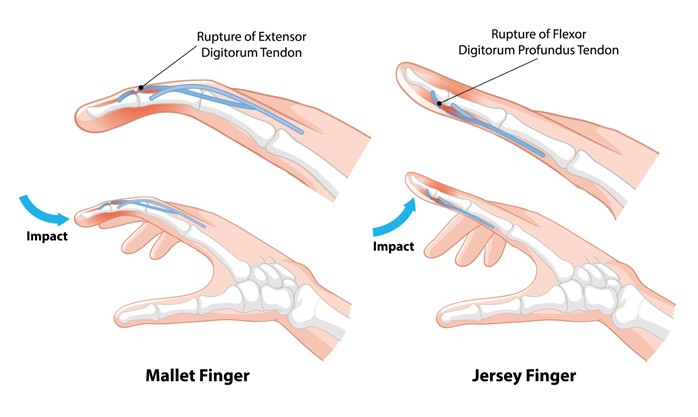
- A sudden force applied to the fingertip, such as a ball striking the hand, can tear or stretch an extensor tendon, leading to conditions like mallet finger.
- Forceful gripping, pulling, or twisting can injure flexor tendons, particularly in high-impact or contact sports.
- Sudden overloading
- A powerful pull on the finger or thumb, such as when catching or lifting a heavy object, can cause the tendon to rupture.
- This is more likely if the tendon has already been weakened by another condition.
- Degenerative conditions
- Some tendon injuries occur in tendons that have become weakened over time due to wear, arthritis, or inflammatory conditions.
- In these cases, even a minor strain can result in a tendon tear.
Because these tendons are essential for hand function, any suspected injury should be assessed promptly. Early diagnosis and treatment give the best chance of restoring strength, movement, and coordination.
Symptoms of Flexor and Extensor Tendon Injuries
The symptoms of a tendon injury in the hand or wrist depend on whether the flexor or extensor tendons are affected, as these control different movements of the fingers and thumb. Common features include:
- Inability to bend the finger or thumb (flexor tendon injury)
- The finger or thumb may remain straight and cannot be actively bent at the affected joint.
- Everyday tasks such as gripping or making a fist may be difficult.
- Inability to straighten the finger or thumb (extensor tendon injury)
- The finger or thumb may remain bent and cannot be actively straightened.
- This includes injuries such as mallet finger, where the fingertip droops down.
- Pain and tenderness
- Pain is often felt at the site of injury, especially when trying to move the affected finger or thumb.
- Swelling and bruising may also be present.
- Visible wound or deformity
- In cases of cuts or lacerations, the tendon may be visibly exposed.
- The finger may appear misshapen or out of alignment.
- Weakness or loss of function
- Reduced grip strength, difficulty holding objects, or clumsiness with fine movements.
- Numbness or tingling
- If nearby nerves are also injured, altered sensation in the finger or hand may be present.
Because tendon injuries can lead to permanent loss of movement if left untreated, prompt assessment is important whenever these symptoms occur. Prof Sallen will carefully evaluate the injury and discuss the most appropriate next steps for treatment.
Diagnosis of Flexor and Extensor Tendon Injuries
Accurate diagnosis of a tendon injury in the hand or wrist is important to guide the right treatment and avoid long-term loss of function. The process usually involves a combination of history, physical examination, and imaging tests if needed.
- Medical history
- Prof Sallen will ask how the injury occurred, when symptoms began, and what movements you find difficult.
- Information about pain, swelling, numbness, or previous injuries helps build a clear picture.
- Physical examination
- Each tendon is tested separately to check whether you can bend or straighten your fingers and thumb against resistance.
- The examination also looks for swelling, deformity, wounds, or signs of nerve or blood vessel damage.
- In open injuries, Prof Sallen will carefully inspect the wound to assess tendon involvement.
- Special clinical tests
- Specific manoeuvres can isolate individual tendons to identify which one is injured.
- For example, inability to bend a single finger joint usually indicates a flexor tendon injury, while a drooping fingertip may indicate an extensor tendon injury (mallet finger).
- Imaging
- Ultrasound can show tendon tears or discontinuity, especially in partial injuries.
- X-rays are often performed to check for associated fractures or foreign bodies.
- MRI may occasionally be recommended for complex or unclear cases.
In most cases, diagnosis can be made with a detailed history and examination alone. Prof Sallen will explain the findings and discuss whether immediate treatment, such as surgical repair, is necessary to restore tendon function.
Flexor and Extensor Tendon Injuries Treatment Options
The goal of treatment is to restore movement, strength, and function to the injured hand or wrist. The right approach depends on the type of tendon involved, the severity of the injury, and whether other structures such as nerves or bones are affected.
Non-surgical treatment
Some partial tendon injuries may be managed without surgery. Options include:
- Splinting – A splint may be used to keep the finger or thumb in a protected position, allowing the tendon to heal.
- Hand therapy – Specialised exercises and therapy can help restore motion and reduce stiffness.
- Activity modification – Avoiding movements that put stress on the healing tendon supports recovery.
Surgical treatment
Complete tendon tears or lacerations usually require surgery to restore function. The procedure involves carefully stitching the tendon ends back together. Key points include:
- Flexor tendon repair – Typically performed through an incision in the palm or finger, the tendon is repaired using fine sutures under magnification.
- Extensor tendon repair – Usually requires a smaller incision on the back of the hand or finger to rejoin the tendon.
- Complex injuries – If the injury involves fractures, nerves, or multiple tendons, these are repaired at the same time.
Recovery and rehabilitation
- After surgery, the hand is usually placed in a splint or cast to protect the repair.
- Hand therapy begins early, with controlled movements designed to prevent stiffness while protecting the repair.
- Recovery takes several months, and commitment to therapy is essential to regain movement and strength.
- The long-term outlook is generally good, although some patients may experience reduced motion or stiffness compared to before the injury.
Prof Sallen will explain the treatment options most suited to your injury and guide you through the recovery process, ensuring your care is tailored to your needs and daily activities.